As we cosy up around the fireside on long winter evenings, thoughts turn towards telling stories of ghosts, spirits and the old ways. Popular Victorian winter past times may arise, such as the retelling of classic gothic ghost stories, seances and tarot reading.
But how much do we really know about tarot, the cartomancy cloaked in mystery that is enjoying a resurgence? And what do we know of the artwork of the tarot cards themselves? Imagery is integral to the reading of these fascinating cards, traditionally associated with fortune tellers looming over crystal balls in dark, hidden corners of traditional caravans, or fairground tents. Cross my palm with silver and I will tell you more…
Just like the Victorian parlours of winters past, the origin of tarot cards is somewhat hazy. Some sources claim they were invented in Italy in the 14th century as simple playing cards. Others believe that tarot decks started to gain significant popularity with occultists of the 18th century, who began using them to foretell the future, illuminate the present and explore the past.
As the meaning behind the cards evolved from play to prophecy, tarot readers embraced cards that were more elaborately illustrated than the original ‘pip’ cards; after all, tarot is as much about intuitive reading of the imagery of the cards as the meanings of the cards themselves. For both readers and querents alike, they are a doorway to an invisible realm with signs, symbols and characters acting as guides in a mystical universe.
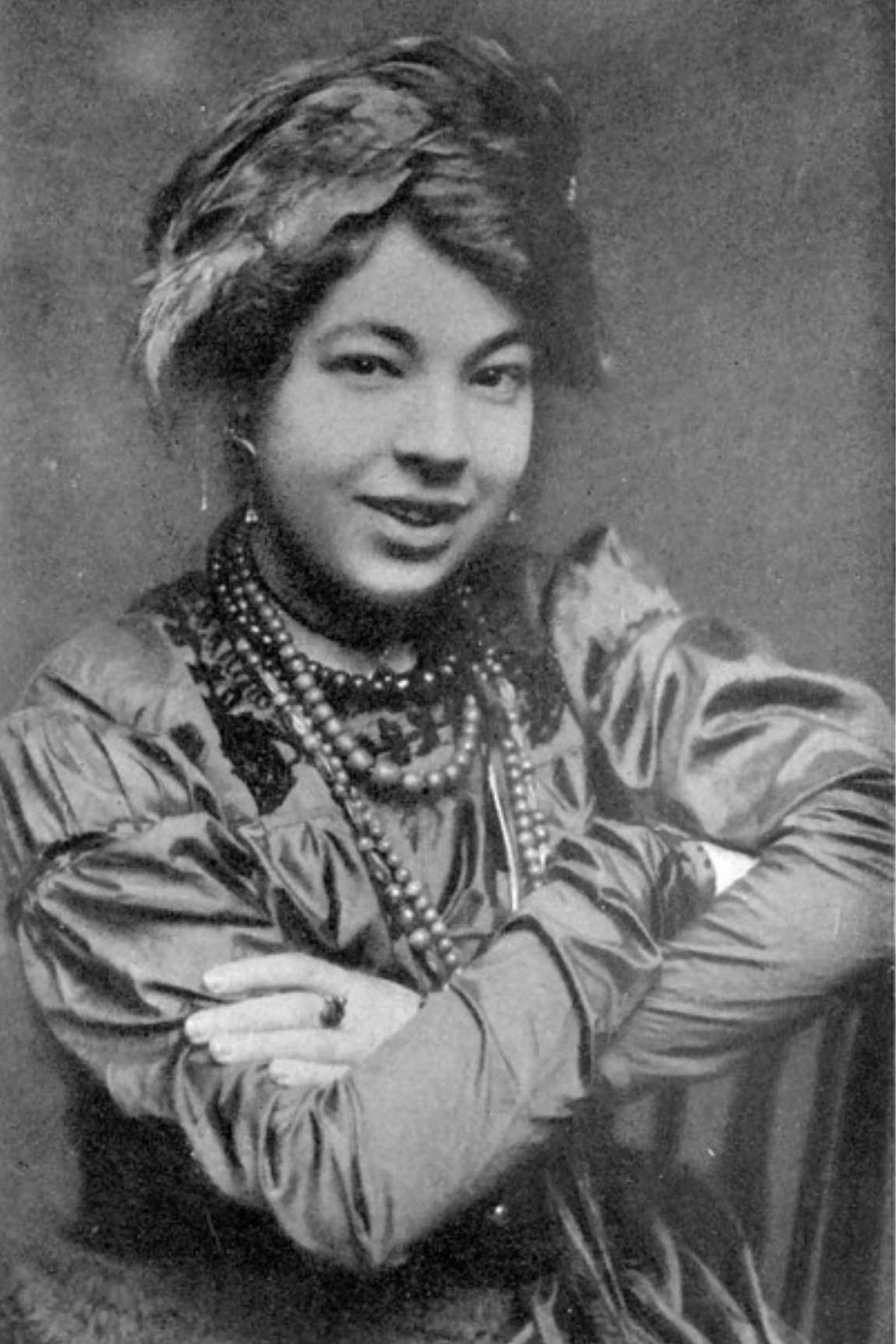
Enter Pamela Colman-Smith (1878 – 1951), a 21 year old female artist who revelled in discovering the hidden world of the paranormal and the occult. Her love of mysticism led her to join secret societies that investigated little known esoterica, such as the kabbalah, Akashic records and of course, tarot.
Her art took inspiration from the folklore of Jamaica where she lived as a child. She wrote and illustrated her own collection of Jamaican folk tales, ‘Annancy Stories’ based on the traditional African folk figure of Anansi the Spider. Her work was revolutionary, demonstrating a mindset far beyond her time. Her narrative was written in Jamaican patois, and many of her characters were of no definitive gender.
Smith carefully curated her physical appearance to convey a sense of her invisible mystical beliefs. She wore turbans and flowing robes, bedecked with jewellery and accessories in the style native to the cultures she lived in. Again, defying convention she was regularly seen wearing stylish, avant-garde trousers. Her unique and inimitable style earned her the magical nickname of ‘Pixie’ (thought to have been christened by actress Ellen Terry): she was also known by the self-styled moniker of ‘Gypsy.’
Her friendship group was one of influential contemporary creatives, most notably the Pre-Raphaelites, William Butler Yeats, and Bram Stoker of ‘Dracula’ fame, for whom she later provided illustrations. Many of the characters she created for the deck were based on her Bohemian circle of friends, whom she drew in her London studio. But it wasn’t all work and no play – she would regale her friends at evening salons with folk tales and the myths and legends she loved so much, going to great lengths to entertain with miniature theatrical productions.
Her fascination with all things spiritual and paranormal imbued her painting with such mystical appeal that it attracted the attention of one A. E. Waite, a Grand Master of the Hermetic Order. Waite had a vision of creating a new version of the 78-card tarot deck, with his own artistic brief for the Major Arcana, and free reign for Smith’s interpretation of the Minor Arcana. This led to her reimagining of this part of the deck, transforming them from simple ‘pip’ cards to the first deck to have Minor Arcana scenes, figures and symbols. Her work is described as the visual manifestation of her:
“…imagination for fantasy, folly, ecstasy, death and the macabre.”
Sharmistha Ray, 2019
Smith’s mystical intuition and creative flair gave birth to the full 78 card deck illustrated in just six months, a remarkable achievement for any artist. Despite its rapid production, the cards stand the test of time, stimulating the imagination and triggering the intuition of the tarot reader even to this day. It is her unique translation of the practical into the fantastical that makes the deck a classic; there are more than 100 million decks in circulation today sold in 20 different countries, making it the most popular set ever made.
To the modern eye her illustrations may not be to everyone’s taste; the illustrations represent white, European culture and heritage with a medieval aesthetic. But it remains the gold standard deck, and the inspiration behind many of the more diverse, modern decks which exist today.
Despite Smith’s integral part in the creation of the deck, it was released under the name of the ‘Rider-Waite Tarot Deck’ by which it is still known. Some scholars and devotees today refer to it as the ‘Waite-Smith Tarot Deck’, with a desire to raise the profile of the forgotten artist behind the iconography. Rider was merely the publisher, yet alongside Waite achieved all popular and financial credit for the deck. Smith received no recognition – she was not awarded copyright nor credited, and paid just a small amount. Women were not permitted intellectual property rights, and her only personal mark is a serpentine ‘PCS’ influenced by traditional Japanese woodblock signatures.
Perhaps it was partly this lack of appreciation that led to her disillusionment with the art world and her subsequent withdrawal to retreat to a life of Catholicism and charity work in Bude, Cornwall. A county rich in myth, folklore and legend, this new home would certainly have satisfied her spiritual side, along with the rituals performed in her religious practices. She died in poverty and remained unrecognised for her phenomenal contribution to the world of tarot.
Many female artists have fallen into obscurity, but with the modern revival in tarot reading, perhaps Smith’s unique and magical talent with finally be recognised. So the next time you’re shuffling your tarot deck, spare a thought for Pamela Colman-Smith – she may just be with you in spirit.
Image: Pamela Colman Smith c. 1897 (photographer unknown). Published in ‘The Craftsman Magazine’, October 1912.
Article published in Myth & Lore zine, 2022
 Lucy Spirit ~ Portfolio
So interesting to learn more about PCS. Gosh what I wouldn’t give to be part of that friendship group!!
LikeLike
Me too!! We will have to start our own! So happy you enjoyed learning more.
LikeLike