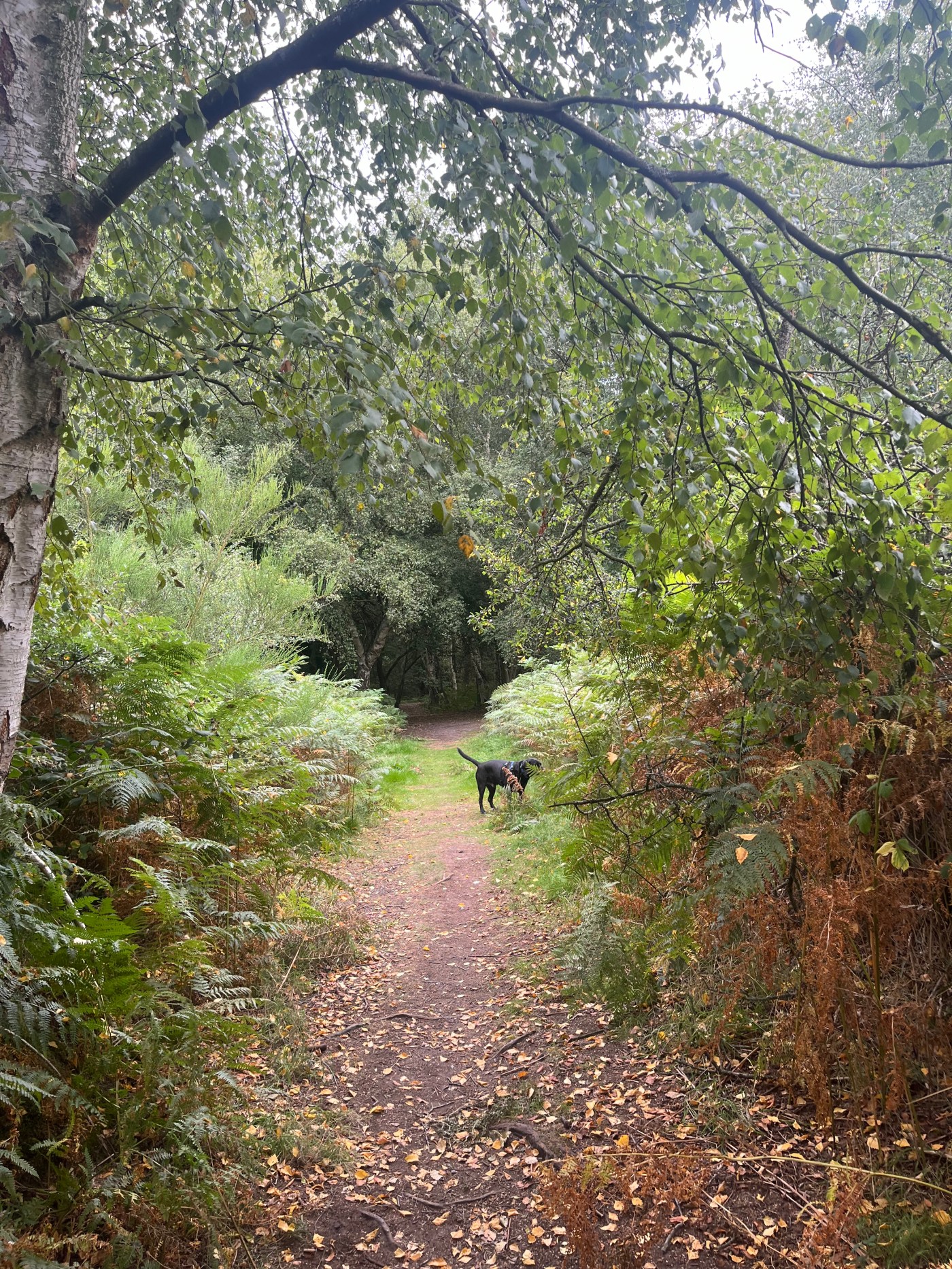
For centuries, folklore countrywide has whispered cautionary tales of phantom black dogs. Some of these souls are benevolent, guiding weary travellers or serving as loyal protectors of innocent children playing in remote rural spots. Others, such as the Shuck and Barguest are harbingers of doom; keepers of the graveyards, waterways and ancient crossroads that pepper our countryside.
It is perhaps inevitable that these supernatural beings are closely linked with our landscape given that they have been an integral part of our everyday lives for centuries; it is thought that dogs were first domesticated in Europe circa 15000 BCE. As time progressed, these faithful creatures became synonymous with the notion of protection and loyalty.
Black dogs in particular, both physical and ghostly, were regarded as benevolent friends, protecting and guiding lost souls. In fact, humankind’s faith in the animal was so great that from approximately 600 AD, black dogs were immured within the foundations of churches, often buried beneath cornerstones in an attempt to ward off evil spirits. A contemporary belief held that the first body buried in a graveyard would protect all future burials’ souls from the devil – what better guardian than a trusty black dog, buried on the northern side of a virgin churchyard?
Centuries later, Christianity made its way to the forefront of societal beliefs and the black dog’s reputation of loyal guardian was entirely reversed. As pagan ways of life were gradually destroyed, the faithful companion was reinvented, becoming a representation of the devil himself – the infamous ‘hell-hound.’ This demonic metamorphosis is illustrated perhaps no more clearly than in the legend of Black Shuck, the snarling beast that terrorised not one, but two church congregations in Norfolk, England in 1577 causing fatalities and life-changing injuries. This visceral embodiment of God’s wrath, a baying, wild creature sent from hell, encouraged parishioners to remain true to their Christian clergy.
Whether friend or foe, the great majority of phantom black dogs have been reported as remarkably similar in appearance. In sharp contrast to their domestic cousins, these spectres are almost always described as the ‘size of a calf’; indeed, it is their sheer size that initially marks them out to the witness as something unearthly. Accordingly, their legs, tails and ears tend to be unusually long, with a coat that is often shaggy and unkempt, adding to their undomesticated appearance. The malicious variants of the species, such as the Barguest and Black Shuck mentioned above, usually have large, bright yellow or red eyes, frequently referred to as the ‘size of saucers.’
Although witness reports mimic each other in visual description, auditory phenomena vary. Some sightings are accompanied by the sound of a rattling chain, others a soft, padding trot and very occasionally, a gut-wrenching growl. More often than not, an ominous silence envelops the onlooker, inducing a nervous, tingling sensation.
Despite geographic variables in county, spectral black dogs as a whole tend to frequent areas of land that are rich in history, bound with ritual and sacrificial use, often sites of countless generations of human activity. As such, encounters in England are most likely to take place in coastal areas and rural locations, particularly along ancient trackways and crossroads. Black dogs are also known to haunt waterways, churchyards and woodland. It is notable that each of these locations in our landscape are imbued with rich spiritual and folkloric history: trackways and crossroads mimic the liminal borders of life and death, and waterways are alive with the energy of centuries old deities (certain black dogs are actually believed to have ‘come from’ water itself). We have seen how unfortunate sacrificial dogs became eternal guardians of churches and churchyards, often built upon much older pre-Christian sacred ground. A favourite haunt is woodland, with some reports stating that the animal has been seen emerging from the trunk of a tree. This leads us to some more specific examples of the types of black dog that have been seen in England.
- The Gurt Dog:
This black dog is usually a kindly soul, most often seen in the Somerset area. He is said to be so benevolent that families would allow their children to play unsupervised in the Quantock Hills, safe in the knowledge that the dog would protect them. In his book ‘Black Dog Folklore’ Mark Norman (p. 37) quotes folklorist Ruth L. Tongue writing in 1960:
‘The Quantock Black Dog can be friendly and has been known to guard and accompany straying small village children picking ‘worts’ or mushrooms. I have heard of cottage women whose toddlers wandered about the nearby coombe, who never worried because ‘the girt old black dog up-over took care of they.’ They did not refer to a farm dog.’
- The Skriker (or Shrieker):
Often encountered in the Lancashire area, this howling spirit is said to haunt crossroads and woodland, uttering piercing cries. It is sometimes known as the Trash. An edition of ‘Notes and Queries’ quoted by Norman (ibid.) states:
‘The name ‘Trash’ is given to it from the peculiar noise made by its feet when passing along, resembling that of a heavy shoe in a miry road. The second appellation is an allusion to the sound of its voice when heard by those parties who are unable to see the apparition itself.’
- Black Shuck:
East Anglia’s very own ‘devil dog’ is a renowned harbinger of doom. Encountering Shuck can result in varying outcomes, ranging from an imminent tumultuous storm to a signifier of death within a year if the unhappy witness happens to look him directly in the eye.
One of Shuck’s twentieth century encounters occurred in 1930 at an ancient landmark, Buxton Lamas church. A gentleman witnessed a ‘large, black shaggy dog’ that aroused no suspicion in him, until he tried to pat it – the dog promptly disappeared. The perplexed witness was further troubled when he later received a letter saying his brother had died in hospital at the exact moment he had seen the phantom dog.
- The Gytrash:
Frequently witnessed in the north of England, the gytrash is a goblin or spirit that can take the form of a horse, mule, cow or indeed, a large black dog. This renowned shape-shifter has a shambling gait, haunting lonely lanes and ancient trackways at night, often leading unsuspecting travellers astray. The Gytrash has been popularised in recent folklore by its appearance in Charlotte Bronte’s ‘Jane Eyre’:
‘…I heard a rush under the hedge, and close down by the hazel stems glided a great dog, whose black and white colour made him a distinct object against the trees. It was exactly one form of…Gytrash— a lion-like creature with long hair and a huge head: it passed me, however, quietly enough; not staying to look up, with strange pretercanine eyes, in my face, as I half expected it would…Nothing ever rode the Gytrash: it was always alone.’
Conversely, there exist reports from north of the border of ghostly black dogs protecting vulnerable travellers. Folklorist Ruth L. Tongue (quoted by Norman (ibid. p.59)) provides us with another fascinating account. An elderly woman recalled a journey one evening, walking alone through a remote area:
‘She was worried because the locality had a bad name for attacks on lonely people, but she became aware of a large black dog keeping alongside, about ten feet away. Her fears left her and she talked to him but got no response. There was a spinney ahead she dreaded but all through its blackness she saw the dog with her. When she came out into the open her cousin’s house was quite close but the dog wouldn’t come in. The cousin…had seen some rough fellows run for their lives just before the solitary figure of the old lady appeared from the spinney. There was nothing with her.’
Despite the variation of character and purpose of folkloric black dogs, there are many commonalities that can be noted. All witnesses describe an almost uniform appearance, and the vast majority of hauntings occur in ancient areas of our landscape, whether it be a churchyard, a lonely woodland or a well-used trackway. Perhaps we can consider embracing the black dog within our practice? We can honour this entity in so many ways – as protector and spirit guide, as prophetic fortune-teller, and as a force of nature emanating from the land itself. For as long as we guard and protect our ancient monuments and landscape, we can rely on the faithful black dog to accompany us in both this world and the next.
With special thanks to folklorist and storyteller Helen J. R. Bruce for generously sharing her knowledge on black dog folkore. For more information, please visit @author_helenjrbruce on Instagram. The book ‘Black Dog Folklore’ by Mark Norman has been an invaluable resource for this article.
Originally published in ‘Witchology’ magazine, October 2024
 Lucy Spirit ~ Portfolio
Leave a comment