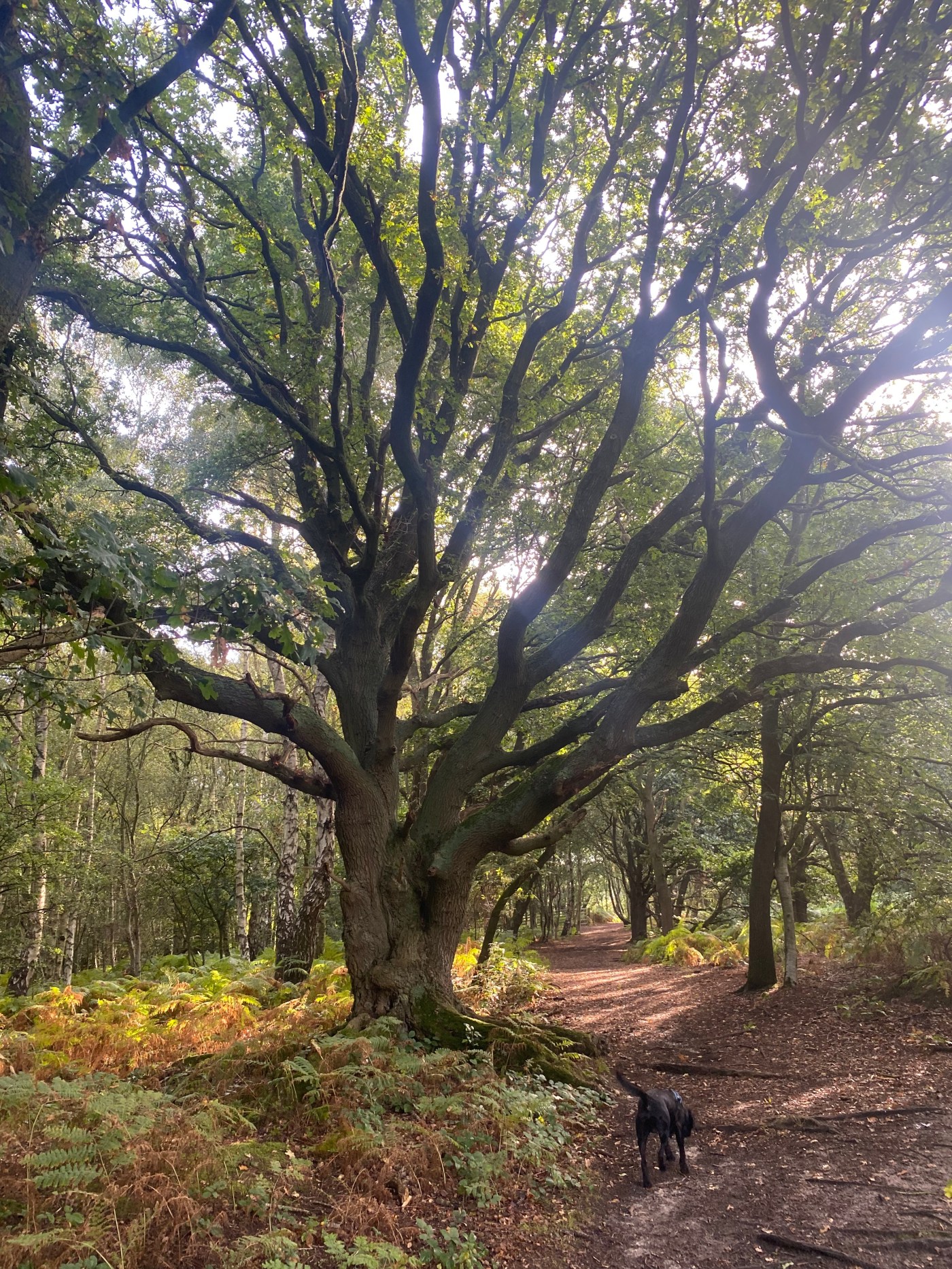
As living creatures, we are all an integral part of earth’s biological cycle of reciprocity; the perpetual give and take between species, a cycle that has existed for millennia. We are surrounded by this every day, celebrating the wheel of the year and the changing seasons. With Autumn approaching, what lessons can we learn from the folklore of the forest?
To my mind, the best way to learn is to explore, and where better to start than my ‘happy place’ – the woods. Meandering the well-trodden paths, musing over what it is exactly about the woods that delights me so much, my eyes are inexplicably drawn to the vivid green, velvety moss cloaking the roots of a majestic oak tree. The moss’s presence is quiet and unobtrusive, yet it begs to be touched – and indeed explored.
A tiny, taupe-coloured butterfly, fearless of the impending drizzle takes me back to my childhood, and tales of little people known as the ‘moss-folk’ or ‘moss-people.’ These woodland dwelling fae are often described as very small and having pairs of delicate wings, often being mistaken for butterflies.
It seems that I was lucky to spot this tiny being at all. Emanating from ancient Germanic folklore, tradition dictates that moss-people stand just three feet tall, and clothe themselves in moss in order to camouflage themselves amongst the very trees in which they live.
Male moss folk are rarely seen, and in his book ‘Teutonic Mythology’ (p. 164) eminent storyteller Jacob Grimm himself recommended that they be avoided due to their ‘nasty tempers.’ Female moss-folk, also known as ‘moss-maidens’ and ‘moss-wives’, are to be positively welcomed however, with their golden hair, emerald-green mossy clothing trimmed with red, and miniature hats jauntily upon their heads.
One lucky group of mortals is said to be able to spot moss-folk with ease. Woodcutters tending and managing the spectacular fir forests of Central Europe had regular interactions with moss-maidens, or ‘wood-wives’. These tiny women would approach those tending the forest to beg for food. This was not solely a plea for charity, but part of a ritual offering/receiving cycle. The moss-maidens would always give in return, in the form of baked goods, or assistance with laundering clothes and kitchen chores, much like the brownies that are more widely known today.
In fact, ancient superstition states that when baking, wood-wives will always be present; they are said to appreciate making use of the fire for their own food preparation. The moss-maidens have few rules for us human folk, but those they do have are strict. Whenever baking, mortals must make an extra loaf especially for them, and never bake on a Friday. By leaving the bread as an offering for the tiny folk, you will receive a gift in return; it is imperative that you accept this gift, as great offence will be taken if one rejects it. And take heed! Moss-folk have a particular hatred of caraway seeds, and will be extremely displeased if caraway bread is offered.
Within rural communities at harvest time, wood-wives are keen to assist farm labourers and vice versa. Grimm (ibid.) describes:
“Men are often on good terms with them: at haymaking or harvest they rake a little heap together, and leave it lying, for “that’s the wood-maidens’ due.”
Interestingly, the moss-folk’s predominantly female presence is said to have been influenced by Grimm’s original written records, taken directly from oral traditions. These have been criticised as leaning towards the author’s Protestant values in Tom Shippey’s ‘Jacob Grimm’s Mythology of the Monstrous’ (pp. 13-14)
“Goddesses…would have strong connections with household virtues. A strong element of nature worship, especially of trees and groves, was also a desideratum.”
These ‘household virtues’ can also be seen in the traditions dictated by the moss-maidens themselves. They are said to be staunch supporters of traditional ways of life, dictated by a variety of commands not limited to forbidding the peeling of bark from a tree and a strict ban on discussing one’s dreams before breakfast. Grimm (p. 165) records:
“A wood-maiden told a woman; ‘Never a fruitful tree pull up. Tell no dream ‘til you’ve tasted a cup.’”
In conjunction with the properties of moss itself, these woodland folk also benefit from any water that humans can provide,
“In pouring out of a dish, when drops hang off the edge, don’t brush them off – they belong to the moss-maiden.”
In her book ‘A Field Guide to the Little People’, (pp. 178-9) Nancy Arrowsmith states that if these simple rules are followed, moss-maidens may become dedicated helpers, who bring great luck if properly fed. She describes them as ‘industrious workers and good housewives with secret knowledge:’
“They know the healing properties of all the plants in the forest and show their favourites how they should be used.”
Upon further investigation, it seems that there is a fascinating cross-cultural, historical importance of the use of moss in everyday life that also explains the heavy emphasis on moss-folk being predominantly female. Although the moss-folk described above are of Germanic folkloric tradition, it would appear that across both European and Native American culture, moss was traditionally associated with the daily activities of women.
In her book ‘Gathering Moss’ Native American botanist and author Robin Wall Kimmerer states (p.113):
“The most important uses of mosses, roles that reflect their best gifts, were everyday tools in the hands of women.”
Within the majority of society today it is no longer considered appropriate to believe that tasks or tools are gender specific. However, within a historical context, it is important to record that women used moss frequently, benefitting from its natural properties. Clothes were lined with moss to provide extra insulation; it was also dried and used as wicks for lamps. Its soft, water absorbing properties meant that it could be used for scrubbing and its astringent and mildly antiseptic qualities made it perfect for use as sanitary pads and nappies, curing nappy rash in the process. In fact, Kimmerer goes so far as to say (p.112):
“A pouch filled with mosses was probably as vital to those mothers as is the ubiquitous nappy bag today…A woman’s life was also intertwined with mosses during her menstrual period. Dry mosses were widely used as sanitary napkins.”
Interestingly, if we turn back to one of the moss-maidens rules – the command that no dream must be discussed before breakfast – we find a link to the properties of a specific type of moss that was used by many cultures as bed-rolls and pillows. ‘Hypnum’ moss, as its name suggests, has the ability to weave a trance-like effect upon the mind of the sleeper, conjuring vivid dreams of the sort that moss-maidens would not discuss on an empty stomach!
This leads us to muse upon the ways in which we can utilise the properties of specific plants to enhance both our rituals, spells and indeed, our lives. As Kimmerer so astutely says (p. 107):
‘Plant knowledge also comes from the plants themselves. To the attentive observer, plants reveal their gifts.’
Let us then show gratitude for the abundance of nature that surrounds those who know where to look. May we only ever take the little that we need and offer our gratitude for the bounty that is returned: for this is the ancient lore of reciprocity.
Originally written for Witch Magazine, Midsummer 2024
 Lucy Spirit ~ Portfolio
Leave a comment