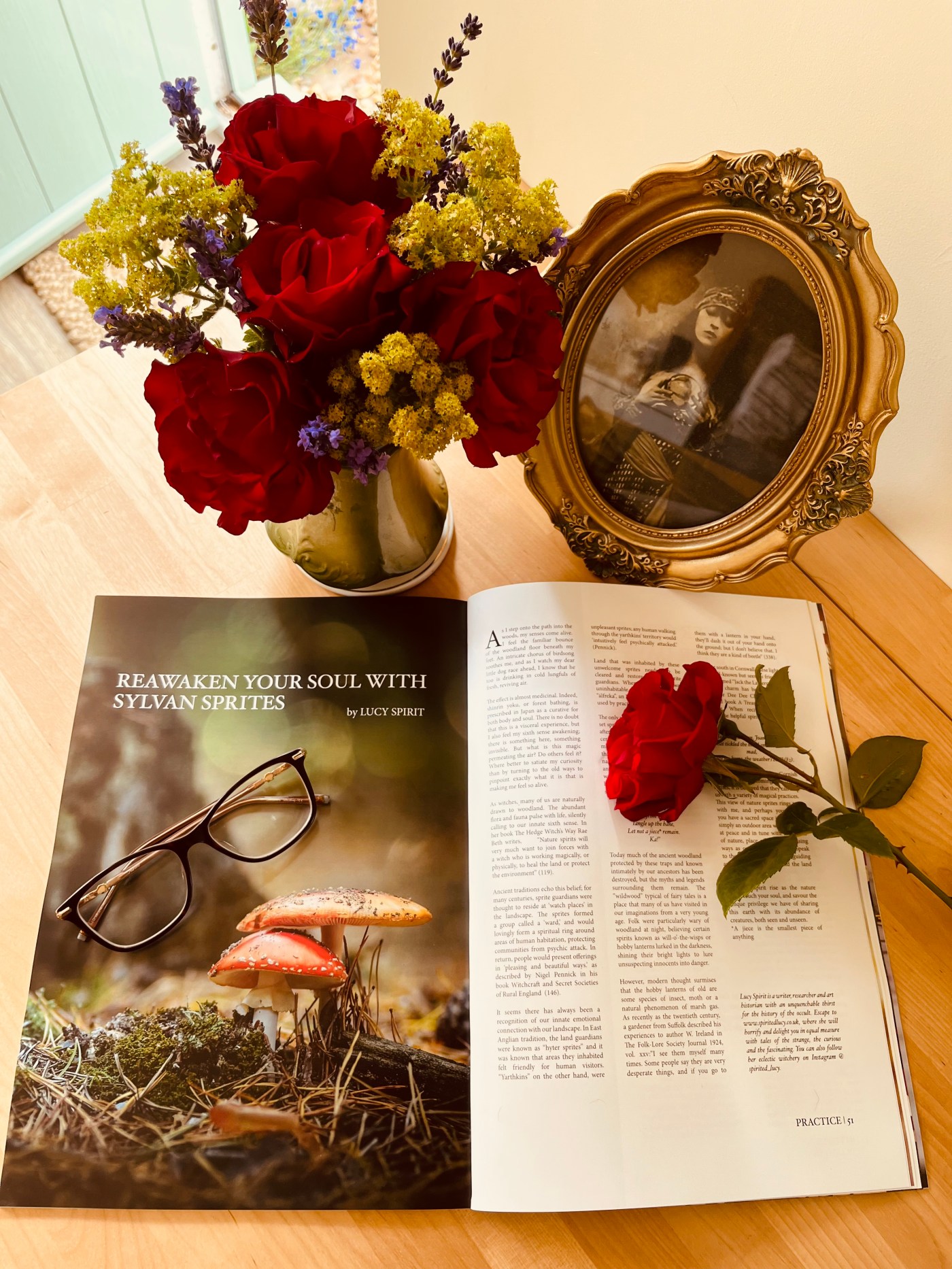
As I step onto the path into the woods, my senses come alive. I feel the familiar bounce of the woodland floor beneath my feet. An intricate chorus of birdsong soothes me, and as I watch my dear little dog race ahead, I know that he too is drinking in cold lungfuls of fresh, reviving air.
The effect is almost medicinal, and indeed shinrin yoku, or ‘forest bathing’, is prescribed in Japan as a curative for both body and soul. There is no doubt that this is a visceral experience, but I also feel my sixth sense awakening; there is something here, something invisible. But what is this magic permeating the air? Do others feel it? Where better to satiate my curiosity than by turning to the old ways to pinpoint exactly what it is that is making me feel so alive.
Many of us are naturally drawn to woodland. The abundant flora and fauna pulse with life, silently calling to our innate sixth sense. Rae Beth writes:
“Nature spirits will very much want to join forces with those who are working magically, or physically, to heal the land or protect the environment.”
Ancient traditions echo this belief; for many centuries sprite guardians were thought to reside at ‘watch places’ in the landscape. The sprites formed a group called a ‘ward’, and would lovingly form a spiritual ring around areas of human habitation, protecting communities from psychic attack. In return, people would present offerings in ‘pleasing and beautiful ways’.
It seems there has always been a recognition of our innate emotional connection with our landscape. In East Anglian tradition the land guardians were known as ‘hyter sprites’ and it was known that areas they inhabited felt ‘good and friendly’ for human visitors. ‘Yarthkins’ on the other hand, were unpleasant sprites; any human walking through the yarthkins’ territory would ‘intuitively feel psychically attacked.’
Land that was inhabited by these unwelcome sprites needed to be cleared and restored to the sprite guardians – uncleansed it was uninhabitable, unusable and termed álfreka’, an Icelandic pagan term still used by practitioners today.
“Where helpful sprites of the land are not acknowledged, or where they have been driven away deliberately, the land is spiritually dead.”
Nigel Pennick, ‘Witchcraft and Secret Societies of Rural England’
The only way to restore the land was to set sprite traps; these were set at night having been constructed at a special ceremony at sunrise. The traps were made from items used in witchcraft that are familiar to many of us today, namely blackthorn, red thread and animal hair. Once caught, the threads were removed and sealed in a witch bottle with a recitation of the spell:
“Thread, tie up this sprite,
Free us from its spite,
Tangle up the bane,
Let not a jiece* remain.
Ka!”
Today much of the ancient woodland protected by these traps and known intimately by our ancestors has been destroyed, but the myths and legends surrounding them remain. The ‘wildwood’ typical of fairy tales is a place that many of us have visited in our imaginations from a very young age. Folk were particularly wary of woodland at night, believing certain spirits known as ‘will-o’-the-wisps’ or ‘hobby lanterns’ lurked in the darkness, shining their bright lights to lure unsuspecting innocents into danger. As recently as the twentieth century, a gardener from Suffolk described his experiences,
“I see them myself many times. Some people say they are very desperate things, and if you go to them with a lantern in your hand, they’ll dash it out of your hand onto the ground; but I don’t believe that. I think they are a kind of beetle.”
Folklore Society Journal, 1924
Indeed, modern thought surmises that the hobby lanterns of old are some species of insect, moth or a natural phenomenon of marsh gas.
Further south in Cornwall, these lights were well-known but seen as a friendly sprite who they termed ‘Jack the Lantern.’ The following charm recited could invoke the helpful spirit of Jack on a dark night:
“Jack the Lantern, Joan the Wad,
That tickled the maid and made her mad,
Light me home, the weather’s bad.”
If we follow suit with the Cornish tradition of welcoming in these sprites, it is believed that they can help us with ‘spells, rituals and healing, or wording of magical chants.’
This view of nature sprites rings true with me, and perhaps you too. If you have a sacred space in nature, or simply an outdoor area where you feel at peace and in tune with the spirits of nature, place offerings in ‘pleasing and beautiful ways’ as our ancestors would. Speak to them, and thank them for guiding and protecting both us and the land we live on.
Feel your spirit rise as the nature spirits touch your soul, and savour the unique privilege we have of sharing this earth with its abundance of creatures – both seen and unseen.
*A jiece is the smallest piece of anything
Published in ‘Witchology’, Summer 2023
Sources:
‘The Hedge Witch’s Way’ by Rae Beth
‘This Hollow Land: Aspects of Norfolk Folklore’ by Peter Tolhurst
‘Folklore Society Journal’ (1924, Various Authors)
‘Witchcraft and Secret Societies of Rural England’ by Nigel Pennick
 Lucy Spirit ~ Portfolio
Leave a comment